Snow Hawk E-Scooter Business Case
A go/no-go business case for a cold-weather electric scooter with heated handlebars and a detachable windshield, aimed at students and young commuters in the Midwest and Northeast.
- Role
- Marketing & product management lead
- Context
- Fall 2024 · OTM 452 product development
- Team
- Four-person team (procurement, sales, marketing & product, engineering/operations)
- Deliverable
- Business case + presentation
Summary
The question
E-scooters are a large and growing market, but almost none are built for snow, cold, and wind. The team had to decide whether a winter-ready scooter could earn back its launch cost at a price students would pay.
What I did
- Sized the opportunity at 9.8 million people aged 18–27 in cold-weather Midwest and Northeast markets and mapped competitors against a $37B e-scooter market growing about 10% a year.
- Owned positioning, prototypes, target audience, sales channels, and the pre- and post-launch marketing plan.
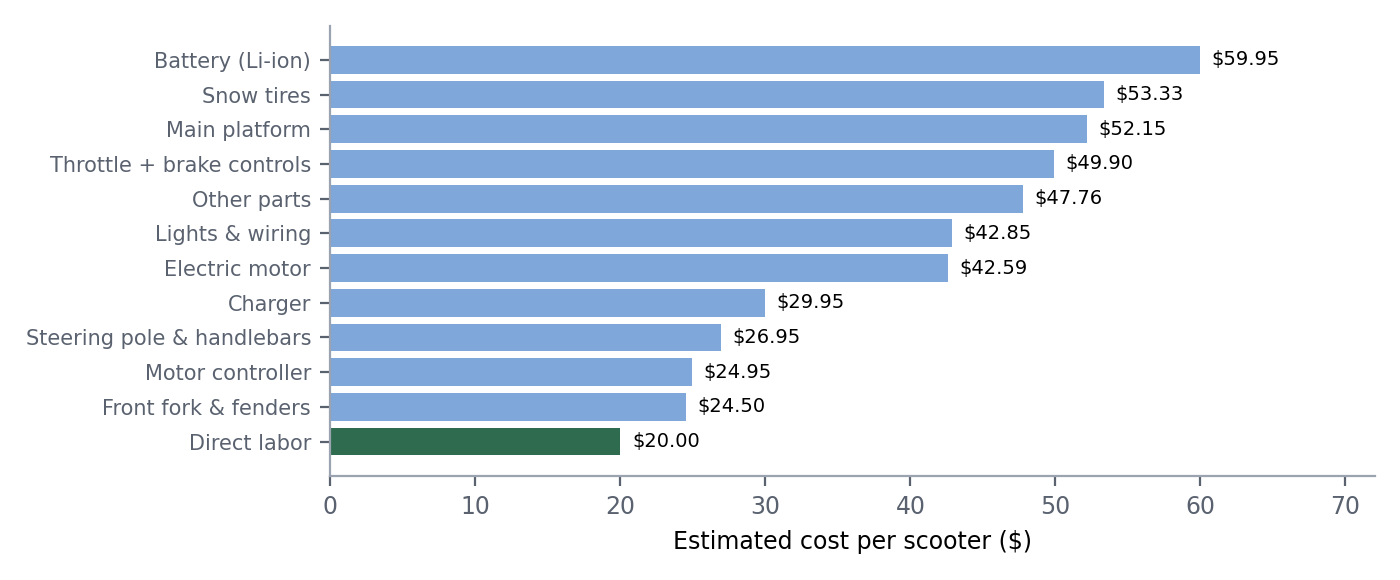
- Built the financials with procurement and operations: $467.56 unit cost against a $750 price, a $960K launch investment, and tariff scenarios that raise unit cost by up to 25%.
What it showed
The product only worked as a niche: a specific customer, a specific season, and a price that covered a higher unit cost. Naming the tariff risk and the mitigation plan made the GO recommendation credible rather than hopeful.
From the work
We recommend that the firm continue with the Snow Hawk Project (GO decision) as there is a substantial market in need of such a niche product. The premium and snow safety focused e-scooter will fill a gap in the market that other competitors have yet to capture.
Phase II business case, recommendation
Charts and slides
| Scenario | Market share | Purchase rate | Units per year |
|---|---|---|---|
| Low volume | 0.09% | 20% of segment | 1,718 |
| High volume | 0.18% | 25% of segment | 4,295 |
In my words
This was the primary output of a product development class. Our team worked through the full launch question – product design, target customer, market size, pricing, and financial viability – before making a go/no-go recommendation. I liked seeing how a product idea had to survive both customer and financial scrutiny.
Documents
If the preview does not load on your device, open the PDF in a new tab.
- Snow Hawk business case briefPDF · 2 pages
Academic team project. Teammates are credited in the documents.